
.jpg)
East
Levante
The long beach and the towers behind it, the loudest and most international part of town, and the end the Serra Gelada path starts from.
A high-rise city on two beaches that divides opinion on sight, and which works year-round almost by accident.
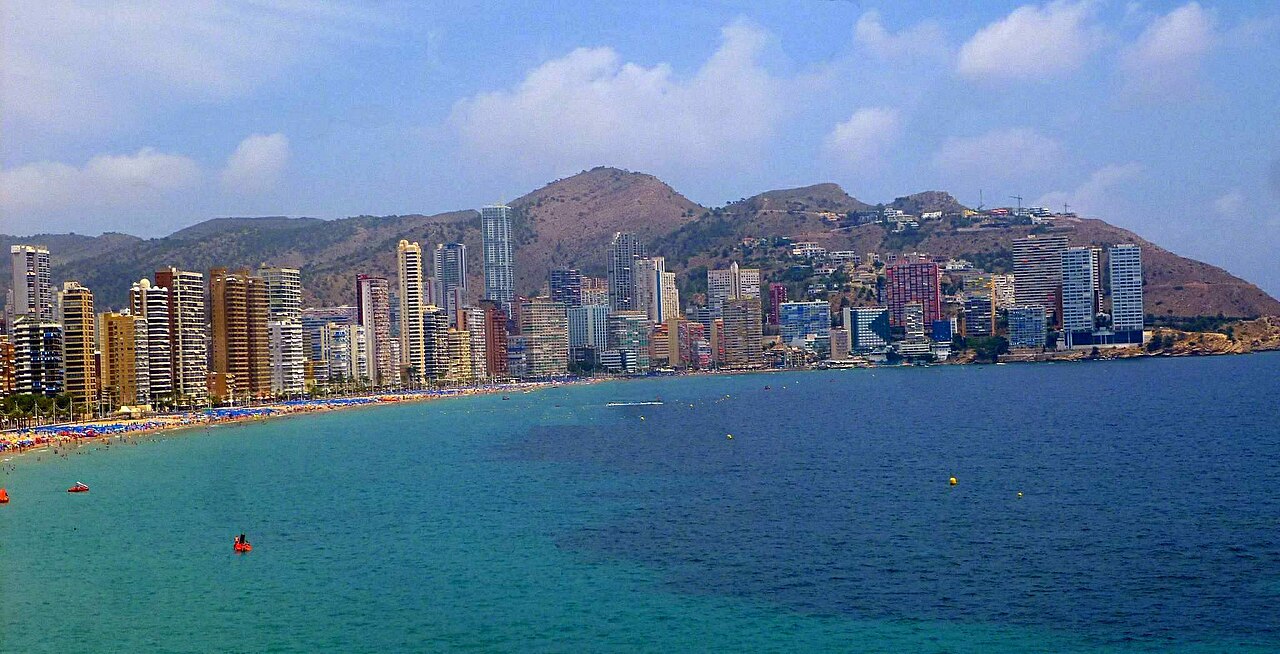
The one everybody has an opinion about. Dense, vertical and unapologetic — and because it was built for volume, it has the infrastructure and the transport that the pretty towns along the bay do not. Whether that trade is worth it depends entirely on what you want from four weeks.
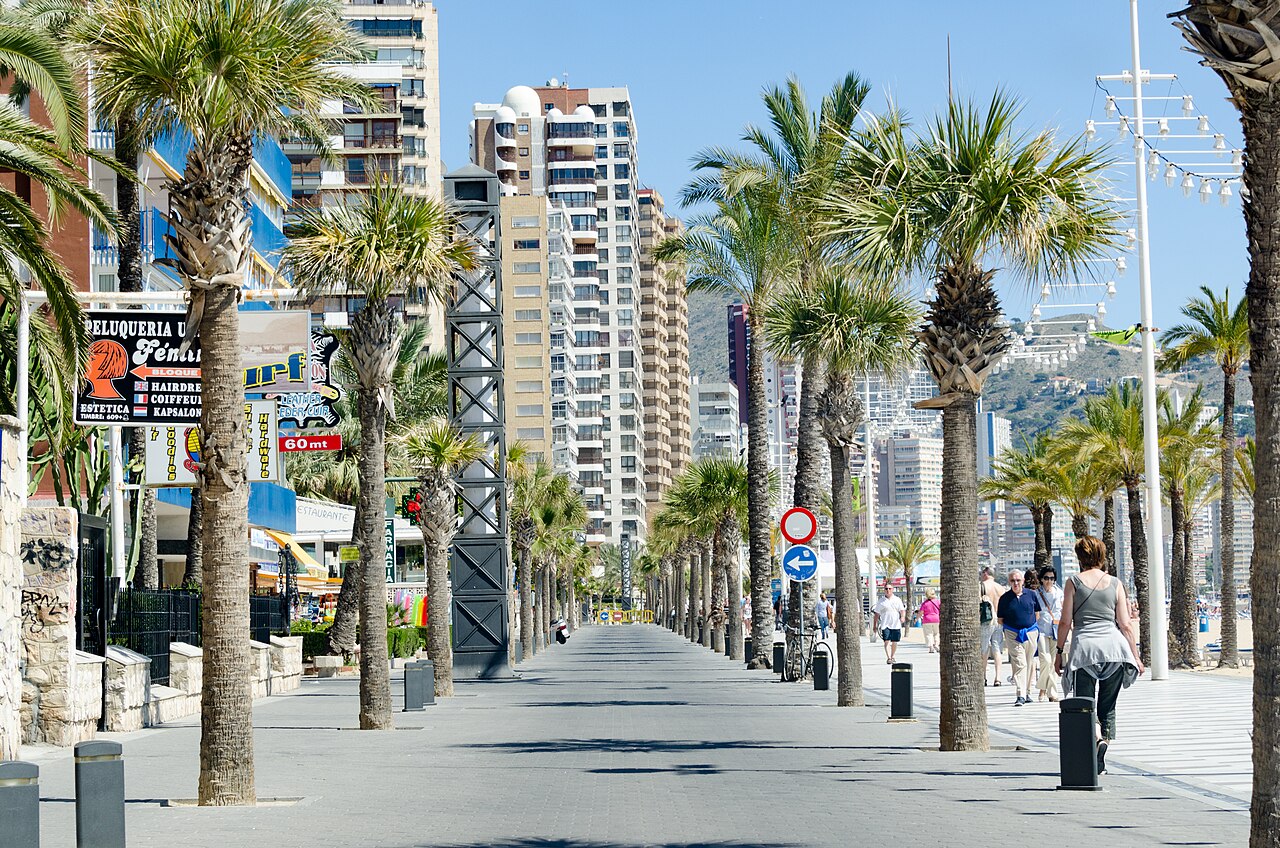
Photographs: Zarateman, CC0 · xiquinhosilva, CC BY 2.0
Which part of town you land in decides what the stay is like — more than the town itself does.
The long beach and the towers behind it, the loudest and most international part of town, and the end the Serra Gelada path starts from.
The old town on the rock between the two beaches — the part that predates everything else and still runs on its own market and church square.
The quieter beach, more residential and more Spanish, with the long promenade and the older apartment stock.
Benidorm went up rather than out, and it is still going. Intempo is the fifth-tallest building in Spain and the Gran Hotel Bali reaches 186 metres1. Whatever else that is, it is a deliberate planning decision rather than an accident.
The density bought the town a transport system the pretty places along the bay do not have. Trams run at least every half hour between Benidorm and Alicante, and hourly north to Dénia1. Benidorm is the interchange: line 1 runs south to Alicante Luceros, line 9 north up the coast through Altea and Calp2.
The permanent population is 77,3273, and a significant number of older northern Europeans spend the winter here1 — which is the mechanism behind the off-season that stays open.
Not Mediterranean at all, technically: Köppen classes Benidorm as hot semi-arid, BSh1. January averages 12.4 °C, August 27 °C, and the town takes 291 mm of rain in a year with more than 3,000 hours of sun1.
That is the driest record of the five towns here and it is not close — Dénia gets two and a half times as much4. The cost is the summer night: average minimums stay above 20 °C right through1. Sleeping is the problem, not working.
Spain is unusually well wired. FTTP reached 89% of premises in 2021 against an EU average of 34%, and connections of at least 100 Mbit/s reached 72%5. A town built vertically and recently is not where fibre goes to fail.
TK: what a connection measures in a 1970s tower block as opposed to a new one, and which coworking spaces are real. Nobody from this project has stayed in Benidorm.
The space profiles say what each house is like to live in, including who it does not suit.