

Under the castle
El Barrio
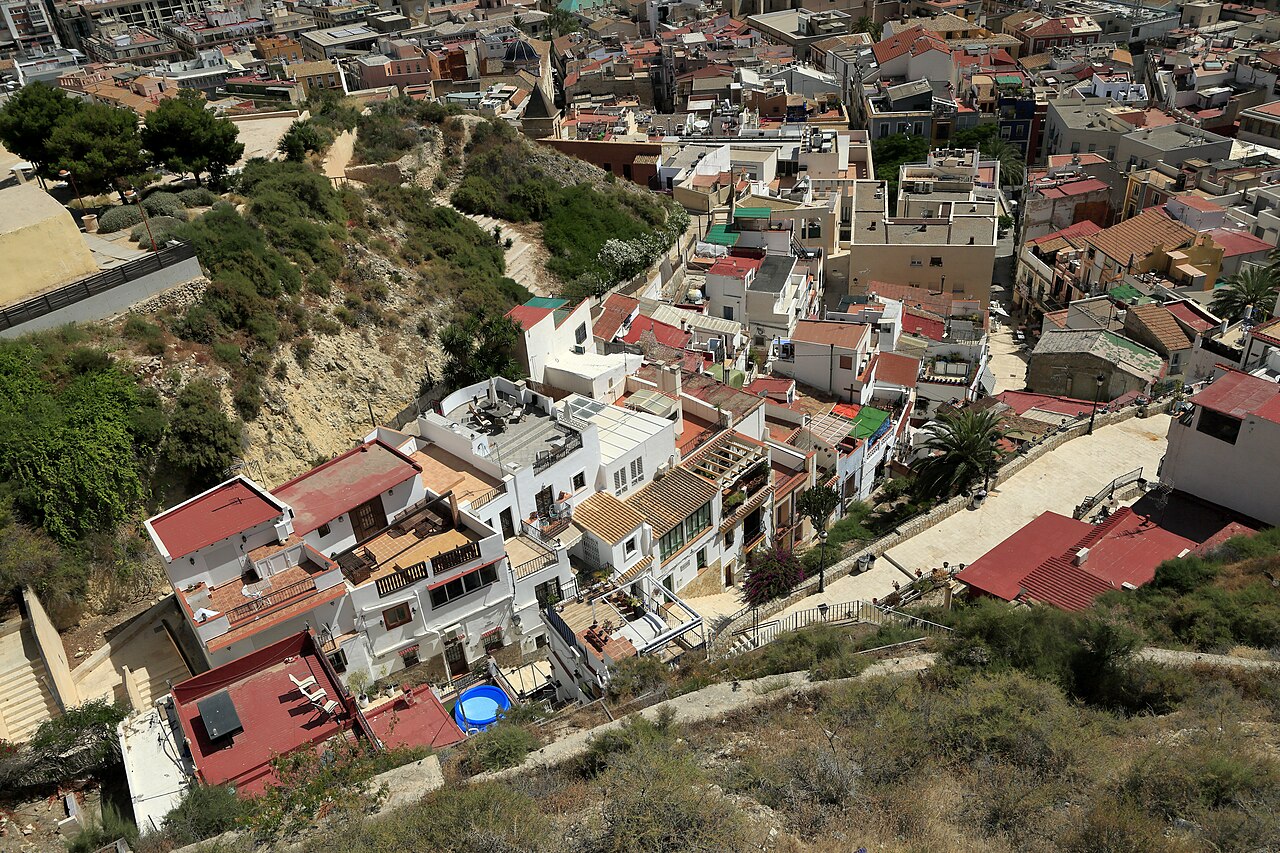
The old quarter on the slope below Santa Bárbara. Beautiful, central, and loud at weekends in a way that decides whether you can sleep.
A provincial capital with a castle on a rock above it — a working city that happens to have a beach, and the only place on this coast with a mainline railway and a major airport.
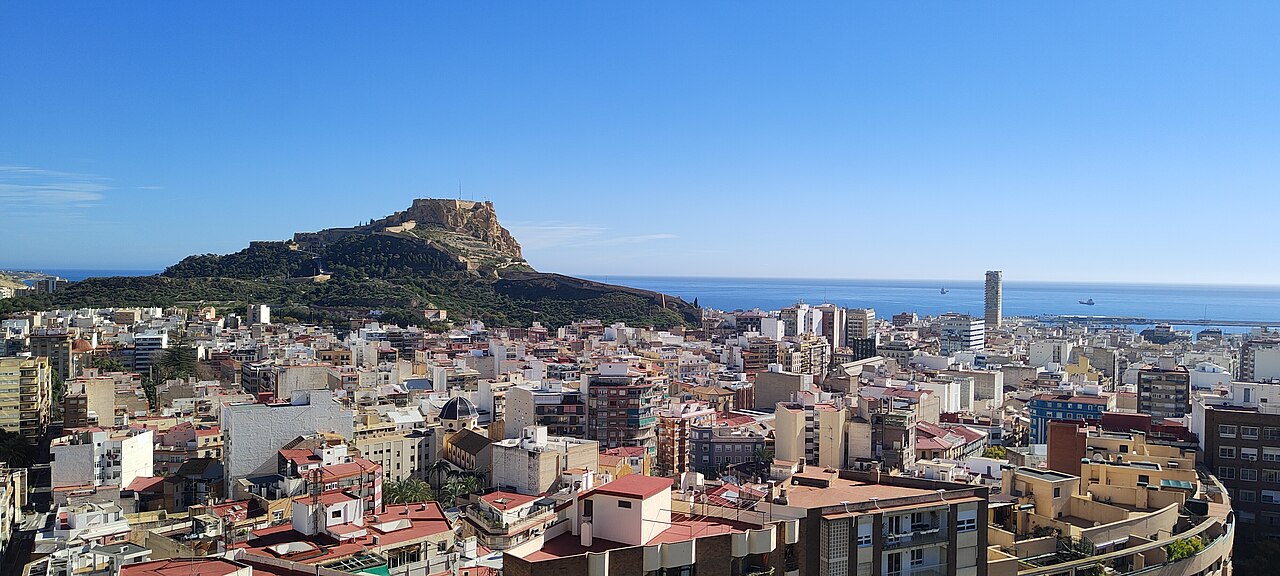
The regional hub, and a straightforward place for a first long stay on the Costa Blanca. A city of a few hundred thousand people with its own economy, a university, an airport with routes across Europe and fast trains to Madrid — so the practical questions that dominate the smaller towns mostly do not arise here.
Photographs: Jumk18, CC BY-SA 4.0 · Falk2, CC BY-SA 4.0
Which part of town you land in decides what the stay is like — more than the town itself does.
The old quarter on the slope below Santa Bárbara. Beautiful, central, and loud at weekends in a way that decides whether you can sleep.
The working centre around the Mercado Central — shops, offices, trams, and most of the flats worth renting for a month.
The long beach a tram ride out of the centre, residential and quieter, with the sand the city beach does not have.
Alicante is the second-largest municipality in the Valencian Community and the tenth in Spain, at 366,221 people1. Everything else on this page follows from that: the questions that dominate the smaller towns are mostly answered here by the city simply being a city.
The rail is the real difference. High-speed services reached Alicante in 2013 on the Madrid–Levante network2, and the fastest Madrid runs now take about 2 h 23, with roughly sixteen trains a day3. No other town on this coast has a mainline station at all.
The airport is among Spain’s busiest, behind only Madrid, Barcelona, Palma and Málaga4. The port runs cruise traffic and ferries to Algeria4. The castle on the photograph above is Santa Bárbara, on Mount Benacantil; its oldest surviving part is the tower called La Torreta4.
Hot semi-arid, BSh, like Benidorm rather than like Dénia4. January averages 12.0 °C and August 26.5 °C, on 284.5 mm of rain a year and more than 3,000 hours of sun4.
That is the driest figure of the five towns covered here. A winter stay in Alicante and a winter stay in Dénia are not the same weather, an hour apart.
Spain is unusually well wired. FTTP reached 89% of premises in 2021 against an EU average of 34%, and connections of at least 100 Mbit/s reached 72%5. In a provincial capital with a university and its own economy, connectivity is not the interesting question.
TK: which barrio suits a month, which coworking spaces are worth the desk, and whether the old town is a place to live or only a place to drink. Nobody from this project has stayed in Alicante.
The space profiles say what each house is like to live in, including who it does not suit.